Biodiesel from waste oil
This is more appealing than using new oil, but it's also more complicated.
First, check for water content. Used oil often has some water in it, and it has to be removed before processing. See Removing the water, below.
Refined fats and oils have a Free Fatty Acid (FFA) content of less than 0.1%. FFAs are formed in cooking the oil, the longer and hotter the oil has been cooked the more FFAs it will contain. FFAs interfere with the transesterification process for making biodiesel. With waste oil you have to use more lye catalyst to neutralise the FFAs. The extra lye turns the FFAs into soap which drops out of the reaction along with the glycerine by-product.
It's essential to titrate the oil to find out how much FFA it contains so you can calculate exactly how much extra lye will be required to neutralise it. This means determining the pH -- the acid-alkaline level (pH7 is neutral, lower values are increasingly acidic, higher than 7 is alkaline). An electronic pH meter is best, but you can also use pH test strips (or litmus paper), or, better than test strips, phenolphthalein solution (from a chemicals supplier).
You can also use red cabbage juice, which changes from red in a strong acid, to pink, purple, blue, and finally green in a strong alkali, or one of the other plant-based pH indicators. See Natural test papers -- Cabbage, Brazil, Dahlia, Elderberry, Indigo, Litmus, Rose, Rhubarb, Turmeric.
We didn't have a pH meter when we started making biodiesel in 1999 so we used phenolphthalein solution. Phenolphthalein is colourless up to pH 8.3, then it turns pink (or rather magenta), and red at pH 10.4. When it just starts to turn pink and stays that way for 15 seconds it's reading pH 8.5, which is the measure you want.
Phenolphthalein lasts about a year. It's sensitive to light, store it in a cool, dark place.
Don't be put off or frightened away by titration. It's not difficult, thousands of non-chemist biodiesel makers have learnt how to do it without difficulty and use it every time they make biodiesel. Just follow the directions, step by step. See also More about lye, Better titration, Joe Street's titrator, Accurate measurements.
Titration
Dissolve 1 gm of lye (KOH or NaOH) in 1 litre of distilled water to make 0.1% w/v lye solution (weight-to-volume). 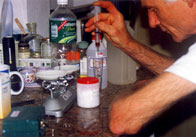
Keith checks the pH of the waste oil.
In a smaller beaker, dissolve 1 ml of the oil in 10 ml of pure isopropyl alcohol. Warm the beaker gently by standing it in some hot water, stir until all the oil dissolves in the alcohol and turns clear. (Chopsticks make good stirrers for titration.)
Add 2 drops of phenolphthalein solution.
Using a graduated syringe or a pipette, add 0.1% lye solution drop by drop to the oil-alcohol-phenolphthalein mixture, stirring all the time. It might turn a bit cloudy, keep stirring. Keep on carefully adding the lye solution until the mixture just starts to turn pink (magenta) and stays that way for 15 seconds.
Take the number of millilitres of 0.1% lye solution you used and add the basic amount of lye needed to process fresh oil -- 3.5 grams for NaOH or 4.9 grams for (pure) KOH. This is the number of grams of lye you'll need per litre of the oil you titrated. (Don't worry that you seem to be adding millilitres to grams, that's the way it works.)
Our first titration took 6 ml of 0.1% NaOH solution (not very good oil), so we used 6 + 3.5 = 9.5 grams of NaOH per litre of oil: 95 grams for 10 litres.
NOTE: Novices should avoid poor-quality oil like this for their first test-batches with used oil. Find a source of oil that titrates at 2 to 2.5 ml of 0.1% NaOH solution, not more than 3 ml. Leave overcooked oils with high titration levels for later when you have more experience. Again, make small one-litre test batches before processing larger batches of WVO.
Proceed as with new oil, see above: measure out the lye and mix it with the methanol to make sodium methoxide or potassium hydroxide -- it will get slightly hotter and take a little longer to mix as there's more NaOH this time. Make sure the NaOH is completely dissolved in the methanol.
Carefully add the methoxide to the warmed oil while stirring, and mix for an hour. Settle overnight, then syphon or decant off the biodiesel.
Check the quality of your biodiesel with this basic quality test.
The first five times we did this, using 10 litres of waste oil each time, we got biodiesel (a bit darker than the new oil product) and glycerine three times, and twice we got jelly. The answer is to be more careful with the titration: do it two or three times, just to be sure. With poor-quality oils that have high titration levels do bracket tests as well. Do everything you can to improve the accuracy of your measurements so you get consistent results. Read on, and you'll learn how to make high-quality biodiesel every time, without fail. (It's a LONG time since we made jelly!)
The production rate was less than with new oil, ending with 8-9 litres of biodiesel instead of 10. With care and experience the production rate improves.
Moving on to bigger things
When you're confident that you can get good results every time, even using oil from different sources, then it's time to scale up the process to provide your fuel needs. Now that you have a feel for the process and know what to expect, you'll have a much better idea of what sort of processor you want than if you'd started off building the processor (as many do) rather than learning the process first.
"Understanding of the process is vital to operate the plant." -- Prof. P.V. Pannir Selvam, Technology Center, Department of Chemical Engineering, Universidade Federal do Rio Grande do Norte (UFRN), Brazil, Biofuel mailing list, 15 Apr 2007
See Biodiesel processors.
However, one-litre test batches are not just something for beginners. It's a basic technique you'll always use. Many experienced biodiesel makers do test batches with each batch of oil. Many not only titrate the oil every time to calculate the right amount of lye to use, they also do "bracket" tests in sequence, followed by wash tests. You learn a lot that way, your fuel gets better, life gets easier.
In fact life is already easier -- people who start off making 40-gallon batches often never learn the accuracy and discipline that comes from making one-litre test batches first. Their fuel quality suffers for it, and when they encounter that inevitable "problem batch", they suffer for it too.
But if you've followed the instructions here carefully, you'll be familiar with all the variables, you'll have good methodology, and you'll be in a much better position to trouble-shoot a problem batch successfully.
Keep a Biodiesel Journal -- make notes, keep records. Get some small glass jars and keep samples of all your batches, clearly labelled and cross-referenced to the notes in your journal. You won't regret it.
When scaling up from small test-batches to a full-sized processor, be aware that the process will probably need some adjusting. All the various processing methods use averages and approximations because processors vary so widely. Blenders especially agitate much faster than any full-scale processor, a real processor will probably take longer to achieve the same result. Use the fuel quality tests to fine-tune it to your particular processor. See Scaling up.
Removing the water
Water in the oil will interfere with the lye, especially if you use too much lye, and you'll end up with jelly. Test first for water content -- heat half a litre or so of the oil in a saucepan on the stove and monitor the temperature with a thermometer. If there's water in it it will start to "snap, crackle and pop" by 50 deg C (120 deg F) or so. If it's still not crackling by 60 deg C (140 deg F) there's no need to dewater it.
See Mike Pelly's recommendations: Removing the water.
Here's another way, from Aleks Kac -- it uses less energy and doesn't risk forming more Free Fatty Acids (see below) by overheating. Heat the oil to 60 deg C (140 deg F), maintain the temperature for 15 minutes and then pour the oil into a settling tank. Let it settle for at least 24 hours. Make sure you never empty the settling vessel more than 90%.
Here's what Biofuel mailing list member Dale Scroggins says about water removal:
Water in vegetable oil can exist as free water, which will eventually settle to the bottom of a vessel; as suspended droplets, which may settle if the oil is heated, or the droplets are coalesced; and as water in solution with other impurities in the oil. Free water is the easiest to remove. The droplets are removed most efficiently by coalescing and draining. Suspended droplets that cannot be coalesced and water in solution are more problematic.
Boiling off the water is more difficult than it appears on the surface. Colligative properties of solutions (and some mixtures) can make removal of the last traces of water almost impossible. Water mixed with oil will not boil at the same temperature and pressure as pure water. As water is removed, more heat or lower pressure will be required to remove more water. If the oil contains salts or semi-soluble fatty acids, distillation is even more difficult.
As the percentage of water in the solution decreases (its molar fraction) its vapor pressure will continue to drop. Lowering pressure in the system alone may be insufficient to sustain vaporization when the solution becomes concentrated (the molar fraction of the solute greatly exceeds that of the solvent). Results will vary depending upon the nature of the water-soluble impurities in the oil. Few solutions are ideal, in terms of Raoult's law, and in used vegetable oil, there is no way to know what solutes are in the oil.
The important thing is how well-used, or overused, the oil is. Titration will tell you that. The higher the titration result, the more water it's likely to contain, and the more difficult it will probably be to remove the water.
Start with heating to 60 deg C and settling, as Aleks Kac recommends, and if that doesn't give satisfactory results, try boiling it off, as Mike Pelly recommends. Then try processing small test batches of a litre or less first. If you still have difficulties, try to find better-quality oil.
Washing
Biodiesel must be washed before use to remove soaps, excess methanol, residual lye, free glycerine and other contaminants. Some people (fewer and fewer of them) say washing isn't necessary, arguing that the small amounts of contaminants cause no engine damage.
Read what the Fuel Injection Equipment (FIE) Manufacturers (Delphi, Stanadyne, Denso, Bosch) have to say about these contaminants:
Summary -- html
Full document -- Acrobat file, 104kb
See also: Determining the Influence of Contaminants on Biodiesel Properties, Jon H. Van Gerpen et al., Iowa State University, July 31, 1996 -- 12,000-word report on contaminants and their effects. Acrobat file, 2.1Mb:
http://www.biodiesel.org/resources/reportsdatabase/reports/gen/gen014.pdf
Myth:
> I did notice that a lot of the chemistry in the book was wrong.
> His main argument seemed to be against losing the energy in
> the methanol that was washed out.
The "energy" does you no good if your particular thermodynamic cycle can't take advantage of it. What is the cetane rating of methanol?
-- Ken Provost, Biofuel mailing list, "Re: washing?"
Quite so. The cetane rating of methanol is only 3, very low. Low cetane-number fuel in a diesel causes ignition delay and makes the engine knock. The high-speed diesel engines in cars and trucks are designed to use fuels with cetane numbers of about 50. The US biodiesel standard specifies a cetane number higher than 47, the EU standard specifies higher than 51. The methanol in unwashed biodiesel doesn't "make a great fuel anyway". It's also very corrosive. The EU biodiesel standard specifies less than 0.2% methanol content.
Quality biodiesel is well-washed biodiesel. Filtering it is no use, and letting it settle for a few weeks won't help much either. Anyway washing the fuel is easy.
See Washing
Using biodiesel
You don't have to convert the engine to run it on biodiesel, but you might need to make some adjustments and you should check a few things.
Petroleum diesel leaves a lot of dirt in the tank and the fuel system. Biodiesel is a good solvent -- it tends to free the dirt and clean it out. Be sure to check the fuel filters regularly at first. Start off with a new fuel filter.
If a car has been left standing for a long time with petroleum diesel fuel in the tank the inside of the tank may have rusted (water content is a common problem with petro-diesel fuel). Biodiesel will free up the rust, and it could clog the particle filter inside the tank. At worst the car simply stops, starved of fuel. It's not a very common problem, but it happens. See: Biodiesel and your vehicle -- Compatability: Filters.
A common warning is that biodiesel, especially 100% biodiesel, will rot any natural or butyl rubber parts in the fuel system, whether fuel lines or injector pump seals, and that they must first be replaced with resistant parts made of Viton. But rubber parts in diesel engine fuel systems have been rare or non-existent since the early 1980s -- it seldom happens, and when it does happen it's not catastrophic, you have plenty of warning and it's easily fixed. See: Biodiesel and your vehicle -- Compatability: Rubber.
See Biodiesel and your vehicle
Safety
Please read this whole section right to the end.
Wear proper protective gloves, apron, and eye protection and do not inhale any vapours. Methanol can cause blindness and death, and you don't even have to drink it, it's absorbed through the skin. Sodium hydroxide can cause severe burns and death. Together these two chemicals form sodium methoxide. This is an extremely caustic chemical.
These are dangerous chemicals -- treat them as such! Gloves should be chemical-proof with cuffs that can be pulled up over long sleeves -- no shorts or sandals. Always have running water handy when working with them. The workspace must be thoroughly ventilated. No children or pets allowed.
Organic vapor cartridge respirators are more or less useless against methanol vapors. Professional advice is not to use organic vapor cartridges for longer than a few hours maximum, or not to use them at all. Only a supplied-air system will do (SCBA -- Self-Contained Breathing Apparatus).
The best advice is not to expose yourself to the fumes in the first place. The main danger is when the methanol is hot -- when it's cold or at "room temperature" it fumes very little if at all and it's easily avoided, just keep it at arm's length whenever you open the container. Don't use "open" reactors -- biodiesel processors should be closed to the atmosphere, with no fumes escaping. All methanol containers should be kept tightly closed anyway to prevent water absorption from the air.
We transfer methanol from its container to the methoxide mixing container by pumping it, with no exposure. This is easily arranged, and an ordinary small aquarium air-pump will do. The methoxide is mixed like this -- Methoxide the easy way, which also happens to be the safe way. The mixture gets quite hot at first, but the container is kept closed and no fumes escape. When mixed, the methoxide is again pumped into the (closed) biodiesel processor with the aquarium air-pump -- there's no exposure to fumes, and it's added slowly, which is optimal for the process and also for safety. See Adding the methoxide.
Once again, making biodiesel is safe if you're careful and sensible -- nothing about life is safe if you're not careful and sensible! "Sensible" also mean not over-reacting, as some people do: "I'd like to make biodiesel but I'm frightened of all those terrible poisons." In fact they're common enough household chemicals. Lye is sold in supermarkets and hardware stores as a drain-cleaner, there's probably a can of it under the sink in most households. Methanol is the main or only ingredient in barbecue fuel or fondue fuel, sold in supermarkets and chain stores as "stove fuel" and used at the dinner table. It's also the main ingredient in the fuel kids use in their model aero engines. So get it in perspective: be careful with these chemicals -- be careful with ALL chemicals -- but there's no need to be frightened of them.
For fire risks, see Hazards
More about methanol
Question: Just how dangerous is methanol?
Fact: Methanol is a poisonous chemical that can blind you or kill you, and as well as drinking it you can absorb it through the skin and breathe in the fumes.
Question: How much does it take to kill you?
Short answer: Anything from five teaspoons to more than half a pint, but nobody really knows.
Fact: Human susceptibility to the acute effects of methanol intoxication is extremely variable. The minimum dose of methanol causing permanent visual defects is unknown. The lethal dose of methanol for humans is not known for certain. The minimum lethal dose of methanol in the absence of medical treatment is put at between 0.3 and 1 g/kg.
That means it's thought to take at least 20 grams of methanol to kill an average-sized person, or 25 ml, five teaspoonsful. Or it might need more than three times as much, 66 grams, 17 teaspoonsful, or maybe more, and even then it'll only kill you if you can't reach a doctor within a day or two, and maybe it still won't kill you.
But it definitely can kill you. If you drink five teaspoonsful of pure methanol you'll need medical treatment even if it doesn't kill you. Yet people have survived doses of 10 times as much -- a quarter of a litre, half a pint -- without any permanent harm. But others haven't survived much lower doses. Getting rapid medical attention is crucial, though the poisoning effects can be slow to develop.
Authorities advise that swallowing up to 1.3 grams or 1.7 ml of methanol or inhaling methanol vapour concentrations below 200 ppm should be harmless for most people. No severe effects have been reported in humans of methanol vapour exposures well above 200 ppm.
Out of 1,601 methanol poisonings reported in the US in 1987 the death rate was 0.375%, or 1 in 267 cases. It might have been only 1 in more than a thousand cases because most cases weren't reported. Most cases were caused by drinking badly made moonshine, which is a worldwide problem.
Fiction: "Methanol is ... a very active chemical against which the human body has no means of defence. It is absorbed easily through the skin and there is no means of elimination from the body, so levels of methanol dissolved in the blood accumulate."
That's from a British website trying to sell Straight Vegetable Oil (SVO) solvent additives by frightening people with the alleged perils of biodiesel. See The SVO vs biodiesel argument
Fact: 30 litres of fruit juice will probably contain up to 20 grams of methanol, near the official minimum lethal dose. Methanol is in the food we eat, in fresh fruit and vegetables, beer and wine, diet drinks, artificial sweeteners.
Not only that, methanol occurs naturally in humans. It's a natural component of blood, urine, saliva and the air you breathe out. It's there anyway even if you've never been exposed to chemical methanol or its fumes.
Methanol is eliminated from the body as a normal matter of course via the urine and exhaled air and by metabolism. Getting rid of it takes from a few hours for low doses to a day or two for higher doses. Some proportion of a dose of methanol just goes straight through, excreted by the lungs and kidneys unchanged. The normal background-level quantities of methanol in humans are eliminated and replenished all the time as a matter of course.
Fiction: It's largely biodiesel's methanol content that's being blamed when the same British SVO website charges that biodiesel is wasteful and environmentally irresponsible.
Fact: Methanol is readily biodegradable in the environment under both aerobic and anaerobic conditions (with and without oxygen) in a wide variety of conditions.
Generally 80% of methanol in sewage systems is biodegraded within 5 days.
Methanol is a normal growth substrate for many soil microorganisms, which completely degrade methanol to carbon dioxide and water.
Methanol is of low toxicity to aquatic and terrestrial organisms and it is not bioaccumulated. (It's toxic mainly to humans and monkeys.)
Environmental effects due to exposure to methanol are unlikely. Unless released in high concentrations, methanol would not be expected to persist or bioaccumulate in the environment. Low levels of release would not be expected to result in adverse environmental effects.
Fiction: A European SVO fuel website using similar anti-biodiesel tactics claims: "Biodiesel is a chemically altered plant oil. However the process to chemically change the structure of Pure Plant Oil is a very costly operation and requires a lot of energy, as it removes the glycerine substituting it by methanol as well as adding other chemicals, making the end-product poisonous and equally hazardous as fossil diesel fuel."
Fact: There is no free methanol in washed biodiesel. All the national standards require washing. According to US EPA studies methyl esters biodiesel is less toxic than table salt and more biodegradable than sugar. It has none of the toxic or environmental hazards of fossil diesel fuel.
To put it all in some perspective, methanol is the main or only ingredient in barbecue fuel or fondue fuel, sold in supermarkets and chain stores as "stove fuel" and used at the dinner table. It's also the main ingredient in the fuel kids use in their model aero engines.
Yes, methanol is a dangerous chemical, but quite how dangerous it may be is a little hard to say, and it causes surprisingly little harm. If you're careful and sensible and treat it with caution it won't harm you either. Many thousands of biodiesel homebrewers worldwide have been using it for years without serious mishap.
In our view, the difference between methanol and the really dangerous chemicals is that although methanol is poisonous, it's a natural chemical, you'd find it in the Garden of Eden too. It's not something nature's simply never heard of before and has no way of handling and neither do you, unlike too many of the 100,000-odd "new" chemicals now in use which aren't readily biodegradable and do accumulate, and spread, and keep being implicated in cancer clusters and bizarre sexual distortions of frogs and so on and on and on.
There are no reports of carcinogenic, genotoxic, reproductive or developmental effects in humans due to methanol exposure. Its environmental effects if any are minimal and short-lived.
Biodieselers can and do use methanol safely and the biodiesel fuel we make from it is safe and clean.


Brak komentarzy:
Prześlij komentarz