Three choices
1. Mixing it
2. Straight vegetable oil
3. Biodiesel or SVO?
Biodiesel
Where do I start?
What's next?
The process
Make your first test batch
Our first biodiesel
Biodiesel from new oil
Biodiesel from waste oil
Moving on to bigger things
Scaling up
Removing the water
Washing
Using biodiesel
Safety
More about methanol
How much methanol?
Ethyl esters -- making ethanol biodiesel
Reclaiming excess methanol
More about lye
Using KOH
How much lye to use?
Basic titration
Better titration
Accurate measurements
Joe Street's titrator
pH meters
Phenolphthalein
pH meters vs phenolphthalein
High FFA levels
Deacidifying WVO
No titration?
The basic lye quantity -- 3.5 grams?
Mixing the methoxide
Stock methoxide solution
Poor man's titration
How much glycerine? Why isn't it solid?
PET bottle mixers
Viscosity testing
How the process works
Animal fats, tallow and lard
What are Free Fatty Acids?
Iodine Values
-- High Iodine Values
-- Talking about the weather
-- Summary
Hydrogenated oil, shortening, margarine
Oxidation and polymerisation
Which method to use?
Why can't I start with the Foolproof method?
Quality
Quality testing
Cetane Numbers
National standards for biodiesel
-- standards and the homebrewer
-- standard testing
Biodiesel in gasoline engines
Storing biodiesel
Home heating
Lamps and stoves
Other uses
Fats and oils -- resources
Diesel information
Identifying plastics
Three choices
There are at least three ways to run a diesel engine on biofuel using vegetable oils, animal fats or both. All three are used with both fresh and used oils.
- Use the oil just as it is -- usually called SVO fuel (straight vegetable oil) or PPO fuel (pure plant oil);
- Mix it with kerosene (paraffin) or petroleum diesel fuel, or with biodiesel, or blend it with a solvent, or with gasoline;
- Convert it to biodiesel.
The first two methods sound easiest, but, as so often in life, it's not quite that simple.
1. Mixing it
Vegetable oil is much more viscous (thicker) than either petro-diesel or biodiesel. The purpose of mixing it or blending it with other fuels is to lower the viscosity to make it thinner so that it flows more freely through the fuel system into the combustion chamber.
If you're mixing veg-oil with petroleum diesel or kerosene you're still using fossil-fuel -- cleaner than most, but still not clean enough, many would say. Still, for every gallon of vegetable oil you use, that's one gallon of fossil-fuel saved, and that much less climate-changing carbon in the atmosphere.
People use various mixes, ranging from 10% vegetable oil and 90% petro-diesel to 90% vegetable oil and 10% petro-diesel. Some people just use it that way, start up and go, without pre-heating it (which makes veg-oil much thinner), or even use pure vegetable oil without pre-heating it.
You might get away with it with an older '80s Mercedes 5-cylinder IDI diesel, which is a very tough and tolerant motor -- it won't like it but you probably won't kill it. Otherwise, it's not wise.
To do it properly you'll need what amounts to an SVO system with fuel pre-heating anyway, preferably using pure petro-diesel or biodiesel for starts and stops. (See next.) In which case there's no need for the mixes.
Blends with various solvents and/or with unleaded gasoline are "experimental at best", little or nothing is known about their effects on the combustion characteristics of the fuel or their long-term effects on the engine.
Higher viscosity is not the only problem with using vegetable oil as fuel. Veg-oil has different chemical properties and combustion characteristics from the petroleum diesel fuel for which diesel engines and their fuel systems are designed. Diesel engines are high-tech machines with very precise fuel requirements, especially the more modern, cleaner-burning diesels (see The TDI-SVO controversy). They're tough but they'll only take so much abuse.
There's no guarantee of it, but using a blend of up to 20% veg-oil of good quality with 80% petro-diesel is said to be safe enough for older diesels, especially in summer. Otherwise using veg-oil fuel needs either a professional SVO solution or biodiesel.
Mixes and blends are generally a poor compromise. But mixes do have an advantage in cold weather. As with biodiesel, some kerosene or winterised petro-diesel fuel mixed with straight vegetable oil lowers the temperature at which it starts to gel. (See Using biodiesel in winter)
More about fuel mixing and blends.
2. Straight vegetable oil
Straight vegetable oil fuel (SVO) systems can be a clean, effective and economical option.
Unlike biodiesel, with SVO you have to modify the engine. The best way is to fit a professional single-tank SVO system with replacement injectors and glowplugs optimised for veg-oil, as well as fuel heating. With the German Elsbett single-tank SVO system for instance you can use petro-diesel, biodiesel or SVO, in any combination. Just start up and go, stop and switch off, like any other car. Journey to Forever's Toyota TownAce van has an Elsbett single-tank SVO system. More
There are also two-tank SVO systems which pre-heat the oil to make it thinner. You have to start the engine on ordinary petroleum diesel or biodiesel in one tank and then switch to SVO in the other tank when the veg-oil is hot enough, and switch back to petro- or biodiesel before you stop the engine, or you'll coke up the injectors.
More information on straight vegetable oil systems here.
3. Biodiesel or SVO?
Biodiesel has some clear advantages over SVO: it works in any diesel, without any conversion or modifications to the engine or the fuel system -- just put it in and go. It also has better cold-weather properties than SVO (but not as good as petro-diesel -- see Using biodiesel in winter). Unlike SVO, it's backed by many long-term tests in many countries, including millions of miles on the road.
Biodiesel is a clean, safe, ready-to-use, alternative fuel, whereas it's fair to say that many SVO systems are still experimental and need further development.
On the other hand, biodiesel can be more expensive, depending how much you make, what you make it from and whether you're comparing it with new oil or used oil (and depending on where you live). And unlike SVO, it has to be processed first.
But the large and rapidly growing worldwide band of biodiesel homebrewers don't mind that -- they make a supply every week or once a month and soon get used to it. Many have been doing it for years.
Anyway you have to process SVO too, especially WVO (waste vegetable oil, used, cooked oil, also called UCO, used cooking oil), which many people with SVO systems use because it's cheap or free for the taking. With WVO food particles and impurities and water must be removed, and it probably should be deacidified too.
Biodieselers say, "If I'm going to have to do all that I might as well make biodiesel instead." But SVO types scoff at that -- it's much less processing than making biodiesel, they say.
To each his own.
x Biodiesel SVO/WVO * Fuel filters might need changing in the first couple of weeks; fuel hoses or seals on some older diesels might need changing. See Biodiesel and your vehicle
Costs and prices: Biodieselers using waste oil feedstock make biodiesel for 50 cents to US$1 per US gallon.
Most people in the US use about 600 gallons of fuel a year (about 10 gallons a week), costing about US$1,800 a year (mid-'07). Petro-diesel costs about three times more in the other industrialised countries (in the UK in mid-'07 it cost the equivalent of US$7.37 for a US gallon of petro-diesel) but those countries generally use less fuel than the US.
Biodieselers will be paying $300-360 for their fuel, while a good processor can be set up for around $100 up. An SVO system costs from about $500 to $1,200 or more. So with an SVO system you'll be ahead of fossil-fuel prices within a year, not a long time in the life of a diesel motor, but you're probably still behind the biodieselers.
Will the engine last as long with SVO? Yes, if you use a good system. Recommendations, and much more, here.
(Note: Small quantities of methanol can cost the equivalent of US$8 to $10 per US gallon, but experienced biodieselers invariably buy it in bulk for about $2-3 per gallon.)
Biodiesel
Converting the oil to biodiesel is probably the best all-round solution of the three options (or we think so anyway).
You could simply buy your biodiesel. Most major European vehicle manufacturers now provide vehicle warranties covering the use of pure biodiesel -- though that might not be just any biodiesel. Some insist on "RME", rapeseed methyl esters, and won't cover use of soy biodiesel (which isn't covered by the Euro biodiesel standard). Germany has thousands of filling stations supplying biodiesel, and it's cheaper there than ordinary diesel fuel. All fossil diesel fuel sold in France contains between 2% and 5% biodiesel. New EU laws will soon require this Europe-wide. Some states in the US are legislating similar requirements. There's a growing number of US suppliers and sales are rising fast, though biodiesel is more expensive than ordinary diesel in the US. In the UK biodiesel is taxed less than petrodiesel and it's available commercially.
But there's a lot to be said for the GREAT feeling of independence you'll get from making your own fuel!
If you want to make it yourself, there are several good recipes available for making high-quality biodiesel, and they say what we also say: some of these chemicals are dangerous, take full safety precautions, and if you burn/maim/blind/kill yourself or anyone else, that will make us very sad, but not liable -- we don't recommend anything, it's nobody's responsibility but your own.
On the other hand, nobody has yet burned/maimed/blinded/killed themselves or anyone else making homebrewed biodiesel. Large numbers of ordinary people all over the world are making their own biodiesel, it's been going on for years, and so far there have been NO serious accidents. It's safe if you're careful and sensible.
"Sensible" also means not over-reacting, as some people do: "I'd like to make biodiesel but I'm frightened of all those terrible poisons." In fact they're common enough household chemicals. Lye is sold in supermarkets and hardware stores as a drain-cleaner, there's probably a can of it under the sink in most households. Methanol is the main or only ingredient in barbecue fuel or fondue fuel, often sold in supermarkets and chain stores as "stove fuel" and used at the dinner table; it's also the main ingredient in the fuel kids use in their model aero engines. So get it in perspective, there's no need to be frightened. See Safety and More about methanol for further information.
Learn as much as you can first -- lots of information is available. Make small test batches before you try large batches (see also Test-batch mini-processor). Make it with fresh oil before you try waste oil -- see next.
Where do I start?
Start with the process, NOT with the processor. The processor comes later.
Start with fresh unused oil, NOT with waste vegetable oil (WVO), that also comes later.
Start by making a small, 1-litre test batch of biodiesel using fresh new oil. You can use a spare blender, or, better, make a simple Test-batch mini-processor.
Keep going, step by step. Study everything on this page and the next page and at the links in the text. There are checks and tests along the way so you won't go wrong.
Go on, do it! Thousands and thousands of others have done it, so can you. Get some methanol, some lye and some new oil at the supermarket and go ahead -- it's a real thrill!
Here's the recipe. Or just keep reading, you'll get to the recipe in a minute anyway.
What's next?
Learn, one step at a time. It's all quite simple really, very few biodiesel homebrewers are chemists or technicians, there's nothing a layman can't understand, and do, and do it well. But there is a lot to learn. You'll find everything you need to know right here. We've tried to make it easy for you. You start off with the simplest process that has the best chance of success and move on step by step in a logical progression, adding more advanced features as you go.
- "I am a pipe welder who knew nothing about chemistry but I have learned a lot from this website. It's set up for someone who has never had a chemistry class (me). If I can understand this anyone can." -- Marty, Biofuel mailing list, 23 Oct 2005
- "For anyone starting out or still in the R&D phase of scaling up and tweaking the process to improve quality, disregard anything other than the tried and tested directions at JtF. Print them out. Read them and then re-read them. Follow the instructions, don't add or subtract anything and you will be making quality biodiesel." -- Tom, Biofuel mailing list, 5 Nov 2005
- "My best advice is to follow explicitly the instructions on the J2F website starting from the begining and you will do just fine. In my own journey of discovery I learned this. You cannot afford to cut corners. Don't be tempted to use less than accurate measures and think that it will be alright. There is no cheating." -- Joe, Biofuel mailing list, 4 Jan 2006
This is how it works -- comment from a Biofuel list member:
"Your website is very well done. I appreciate the layers of technical complexity. You have progressively more technical information layered in an escalating and logical fashion. I like the links as each new item is introduced, the user can click for more specific information on a topic and it opens in a new window. This eliminates the tediousness of having to constantly backtrack to where the new concept was introduced."
The process
Vegetable and animal fats and oils are triglycerides, containing glycerine. The biodiesel process turns the oils and fats into esters, separating out the glycerine. The glycerine sinks to the bottom and the biodiesel floats on top and can be syphoned off.
The process is called transesterification, which substitutes alcohol for the glycerine in a chemical reaction, using lye as a catalyst. See How the process works
Chemicals needed
The alcohol used can be either methanol, which makes methyl esters, or ethanol (ethyl esters). Most methanol comes from fossil fuels (though it can also be made from biomass, such as wood), while most ethanol is plant-based (though it is also made from petroleum) and you can distill it yourself. There is as yet no "backyard" method of producing methanol. But the biodiesel process using ethanol is more difficult than with methanol, it's not for beginners. (See Ethyl esters.)
Ethanol (or ethyl alcohol, grain alcohol -- EtOH, C2H5OH) also goes by various other well-known names, such as whisky, vodka, gin, and so on, but methanol is a poison. Actually they're both poisons, it's just a matter of degree, methanol is more poisonous. But don't be put off -- methanol is not dangerous if you're careful, it's easy to do this safely. Safety is built-in to everything you'll read here. See Safety. See More about methanol.
Methanol is also called methyl alcohol, wood alcohol, wood naphtha, wood spirits, methyl hydrate (or "stove fuel"), carbinol, colonial spirits, Columbian spirits, Manhattan spirits, methylol, methyl hydroxide, hydroxymethane, monohydroxymethane, pyroxylic spirit, or MeOH (CH3OH or CH4O) -- all the same thing. (But, confusingly, "methylcarbinol" or "methyl carbinol" is used for both methanol and ethanol.)
You can usually get methanol from bulk liquid fuels distributors; in the US try getting it at race tracks. With a bit of patience, most people in most countries manage to track down a source of methanol for about US$2-3 per US gallon.
For small amounts, you can use "DriGas" fuel antifreeze, one type is methanol (eg "HEET" in the yellow container), another is isopropyl alcohol (isopropanol, rubbing alcohol), make sure to get the methanol one.
Methanol is also sold in supermarkets and chain stores as "stove fuel" for barbecues and fondues, but check the contents -- not all "stove fuel" is methanol, it could also be "white gas", basically gasoline. It must be pure methanol or it won't work for making biodiesel. See Methanol suppliers
Methylated spirits (denatured ethanol) doesn't work; isopropanol also doesn't work.
The lye catalyst can be either potassium hydroxide (KOH) or sodium hydroxide (caustic soda, NaOH).
NaOH is often easier to get and it's cheaper to use.
KOH is easier to use, and it does a better job. Experienced biodieselers making top-quality fuel usually use KOH, and so do the commercial producers. (KOH can also provide potash fertiliser as a by-product of the biodiesel process.)
With KOH, the process is the same, but you need to use 1.4 times as much (1.4025). (See More about lye.)
You can get both KOH and NaOH from soapmakers' suppliers and from chemicals suppliers.
NaOH is used as drain-cleaner and you can get it from hardware stores. It has to be pure NaOH. Shake the container to check it hasn't absorbed moisture and coagulated into a useless mass, and make sure to keep it airtight.
The Red Devil-brand NaOH lye drain-cleaner previously sold in the US is no longer made. Don't use Drano or ZEP drain-cleaners or equivalents with blue or purple granules or any-coloured granules, it's only about half NaOH and it contains aluminium -- it won't work for biodiesel.
CAUTION:
Lye (both NaOH and KOH) is dangerous -- don't get it on your skin or in your eyes, don't breathe any fumes, keep the whole process away from food, and right away from children. Lye reacts with aluminium, tin and zinc. Use HDPE (High-Density Polyethylene), glass, enamel or stainless steel containers for methoxide. (See Identifying plastics.) See Safety
See also Making lye from wood ash.
Chemicals for WVO
Isopropanol for titration is available from chemicals suppliers. Some people have used the other kind of Dri-Gas, which is isopropanol, but they found that it's unreliable. Best get 99% pure isopropanol from a chemicals supplier. 70% pure isopropanol is also said to work, but we found it didn't give satisfactory results.
Contrary to rumour, "phenol red", sold by pool supply stores and used for checking water, won't work for titrating WVO, its pH range isn't broad enough. Use phenolphthalein indicator, specifically 1% phenolphthalein solution (1.0w/v%) with 95% ethanol. Phenolphthalein lasts about a year. It's sensitive to light, store it in a cool, dark place. You can get it from chemicals suppliers. See: Phenolphthalein
Make your first test batch
Here's what you need:
- 1 litre of new vegetable oil, whatever the supermarket sells as cooking oil
- 200 ml of methanol, 99+% pure
- lye catalyst -- either potassium hydroxide (KOH) or sodium hydroxide (NaOH)
- blender or mini-processor
- scales accurate to 0.1 grams, preferably less -- 0.01 grams is best
- measuring beakers for methanol and oil
- half-litre translucent white HDPE (#2 plastic) container with bung and screw-on cap
- 2 funnels to fit the HDPE container
- 2-litre PET bottle (water or soft-drinks bottle) for settling
- two 2-litre PET bottles for washing
- duct tape
- thermometer
See Accurate measurements
All equipment should be clean and dry.
For methanol, you can use "DriGas" fuel antifreeze from an automotive store. One type of DriGas is methanol, another is isopropanol, make sure to get the methanol one. Also try "stove fuel" from hardware stores or home centres (but check the contents to make sure it's pure methanol, it could also be "white gas", which is gasoline and doesn't work), or try a chemicals supply company. See Methanol suppliers
You can get lye at hardware stores, or from soapmakers' suppliers (try online). KOH lye (potassium hydroxide) works better than NaOH (sodium hydroxide). "Red Devil" NaOH lye drain-cleaner is no longer made. Don't use Drano or ZEP drain-cleaners or equivalents with blue or purple granules or any-coloured granules, it's only about half NaOH and it contains aluminium, it won't work for biodiesel. Shake the container to check it hasn't absorbed moisture and coagulated into a useless mass, and make sure to keep it airtight.
1. Safety
Read and observe the Safety instructions below.
2. Lye
You need to be quick when measuring out the lye because it very rapidly absorbs water from the atmosphere and water interferes with the biodiesel reaction.
Measure the lye out into a handy-sized lightweight plastic bag on the scales (or even do the whole thing entirely inside a big clear plastic bag), then close the lid of the container firmly and close the plastic bag, winding it up so there's not much air in it with the lye and no more air can get in. Have exactly the same kind of bag on the other side of the scale to balance the weight, or adjust the scale for the weight of the bag.
How much to use. NaOH must be at least 97% pure, use exactly 3.5 grams. If you're using KOH it depends on the strength. If it's 99% pure (rare) use exactly 4.9 grams (4.90875). If it's 92% pure (more common) use 5.3 grams (5.33), with 90% pure use 5.5 grams (5.454), with 85% pure use 5.8 grams (5.775). Any strength of KOH from 85% or stronger will work.
3. Mixing the methoxide
Use the "Methoxide the easy way" method -- it's also the safe way. Here's how to do it.
Measure out 200 ml of methanol and pour it into the half-litre HDPE container via the funnel. Methanol also absorbs water from the atmosphere so do it quickly and replace the lid of the methanol container tightly. Don't be too frightened of methanol, if you're working at ordinary room temperature and you keep it at arm's length you won't be exposed to dangerous fumes. See More about methanol.
Carefully add the lye to the HDPE container via the second funnel. Replace the bung and the screw on the cap tightly.
Shake the container a few times -- swirl it round rather than shaking it up and down. The mixture gets hot from the reaction. If you swirl it thoroughly for a minute or so five or six times over a period of time the lye will completely dissolve in the methanol, forming sodium methoxide or potassium methoxide. As soon as the liquid is clear with no undissolved particles you can begin the process.
The more you swirl the container the faster the lye will dissolve. With NaOH it can take from overnight to a few hours to as little as half-an-hour with lots of swirling (but don't be impatient, wait for ALL the lye to dissolve). Mixing KOH is much faster, it dissolves in the methanol more easily than NaOH and can be ready for use in 10 minutes.
4. The process
Using a blender. Use a spare blender you don't need or get a cheap second-hand one -- cheap because it might not last very long, but it will get you going until you build something better.
Check that the blender seals are in good order. Make sure all parts of the blender are clean and dry and that the blender components are tightly fitted.
Pre-heat the oil to 55 deg C (130 deg F) and pour it into the blender.
With the blender still switched off, carefully pour the prepared methoxide from the HDPE container into the oil.
Secure the blender lid tightly and switch on. Lower speeds should be enough. Mix for 20-30 minutes.
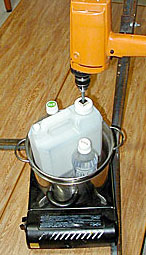 Using a mini-processor. Follow the instructions here and improvise where necessary -- there are many ways of building a processor like this.
Proceed with processing as above, maintain temperature at 55 deg C (130 deg F), process for one hour.
4. Transfer
As soon as the process is completed, pour the mixture from the blender or the mini-processor into the 2-litre PET bottle for settling and screw on the lid tightly. (As the mixture cools it will contract and you might have to let some more air into the bottle later.)
5. Settling
Allow to settle for 12-24 hours. 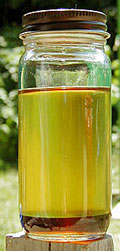
Freshly made biodiesel, 20 minutes after processing
Darker-coloured glycerine by-product will collect in a distinct layer at the bottom of the bottle, with a clear line of separation from the pale liquid above, which is the biodiesel. The biodiesel varies somewhat in colour according to the oil used (and so does the by-product layer at the bottom) but usually it's pale and yellowish (used-oil biodiesel can be darker and more amber). The biodiesel might be clear or it might still be cloudy, which is not a problem. It will clear eventually but there's no need to wait.
Carefully decant the top layer of biodiesel into a clean jar or PET bottle, taking care not to get any of the glycerine layer mixed up with the biodiesel. If you do, re-settle and try again.
6. Quality
Proceed to the wash-test to check the quality. If your biodiesel doesn't pass the test, here's what to do next.
7. Washing
If it passes the wash-test then wash the rest of the biodiesel. See Washing. For washing use the two 2-litre PET bottles in succession, with half a litre of tap water added for each of the three or four washes required. Pierce a small 2mm hole in the bottom corner of each of the two bottles and cover the hole securely with duct tape.
Pour the biodiesel into one of the wash bottles. Add the half-litre of fresh water.
a. Bubble-washing. See instructions here. Use a small aquarium air-pump and an air-bubbler stone -- cut the threaded lid off the wash bottles if necessary to get the stone in. After washing and settling, drain off the water from the bottom of the bottle by removing the duct tape from the hole. Block it again with your finger when it reaches the biodiesel. Transfer the biodiesel to the second wash bottle, add fresh water and wash again. Clean the first bottle and replace the duct tape. Repeat until finished.
b. Stirring. See instructions here. If you have a small enough paint stirrer and a variable-speed drill, cut the lids off the bottles as above to accommodate the stirrer. Stir until oil and water are well mixed and appear homogenous. Settle for two hours or more, drain as above for bubble-washing, repeat until finished.
If you don't have a stirrer, don't cut the lids off the wash bottles. Add the biodiesel and the water as above. Screw the cap on tightly. Turn the bottle on its side and roll it about with your hands until oil and water are well mixed and homogenous. Settle, drain as above for bubble-washing, repeat until finished.
8. Drying
When it's clear (not colourless but translucent) it's dry and ready to use. It might clear quickly, or it might take a few days or up to a week. If you're in a hurry, heat it gently to 48 deg C (120 deg F) and allow to cool.
9. Congratulations! You have just made high-quality diesel fuel. Say goodbye to ExxonMobil & Co., you don't need them anymore.
10. Read on!
Next step
 Our first biodiesel
This was just an investigative project for us when we made our first biodiesel more than seven years ago in Hong Kong. Most of the equipment was rough and improvised. Apart from chemicals and some beakers, syringes and so on, the only thing we bought was a set of scales.
We got some sodium lye draincleaner from a hardware store and about 60 litres of used cooking oil from Lantau Island's local McDonald's. There were four 16-litre cans of it, a mix of used cooking oil and residual beef and chicken fats. Two of the tins were solidified, the other two held a gloppy semi-liquid. We warmed it up a bit on the stove (to about 50 deg C, 122 deg F) and filtered it through a fine mesh filter, and then again through coffee filter papers, but it was fairly clean -- very little food residue was left in the filters.
We'd also bought 10 litres of the cheapest new cooking oil we could find -- we don't know what kind of oil it was, the tins only said "Cooking Oil" -- and we used this for our first experiment. 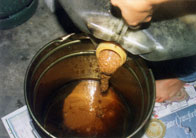
Used cooking oil from McDonald's.
It worked, though two of our first six batches failed. We've learnt a lot since then. Now it's easy to make high-quality biodiesel every time without fail. And we don't use open containers for processing now, and neither should you (see Safety, see Processors) -- and mix the methanol in closed containers too.
Practices, knowledge, technology, equipment and safety measures have all improved tremendously in the years since we brewed our first batch, thanks mainly to the collaborative work of thousands of biofuellers worldwide at the Biofuel mailing list and other Internet forums, using the growing body of information at our website and others. 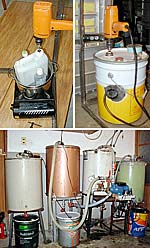
Simple, safe, efficient biodiesel processors you can build cheaply and easily
As a Biofuel list member said in 2002: "I just want to say how important what you all are doing here is. Closed-system fuel production, on a local or small regional scale, tied to local resources, using accessible technologies, and dependent on entrepreneurial innovation combined with open-source information exchange -- it's AWESOME. Keep up the good work everyone, before the planet fries."
Biodiesel from new oil
Make your first test-batch using one litre of new oil (fresh, uncooked). Follow the instructions above. Check the quality of your biodiesel with this basic quality test.
We had difficulty finding pure methanol in Hong Kong, and eventually paid the very high price of US$10 per litre for 5 litres from a wholesale chemical supply company. It has to be 99% pure or better. (See Methanol suppliers)
We used sodium lye drain-cleaner (NaOH, sodium hydroxide) bought in small plastic containers at a local hardware store, not always very fresh. (We recommend using potassium hydroxide, KOH, instead of NaOH. See More about lye.)
We used 2 litres of methanol to 10 litres of vegetable oil, and 3.5 grams of NaOH per litre of oil -- 35 grams for 10 litres. (It's better to start with smaller one-litre test batches.)
We had to be quick measuring out the 35 grams of lye required. Lye is very hygroscopic, it absorbs moisture from the air; summer humidity in Hong Kong is usually about 80% at 30 deg C or more, and the lye rapidly got wet, making it less effective. (See More about lye.)
We mixed the lye with the 2 litres of methanol in a strong, heatproof glass bottle with a narrow neck to prevent splashing. It fumed and got hot, and took about 15 minutes to mix. (Use closed containers for mixing methoxide! See above, Mixing the methoxide.)
This mixture is sodium methoxide, a powerful corrosive base -- take full safety precautions when working with sodium methoxide, have a source of running water handy.
Meanwhile we'd warmed the 10 litres of new oil in a 20-litre steel oil drum to about 40 deg C (104 deg F) to thin it so it mixed better (55 deg C, 131 deg F, is a better processing temperature). Don't let it get too hot or the methanol will evaporate. (Methanol boils at 64.7 deg C, 148.5 deg F.) 
Midori checks the temperature of the oil.
We'd made a wooden jig with a portable vice clamped to it holding a power drill fitted with a paint mixer to stir the contents of the oil drum. This did a good job without splashing. (Not advised, it's dangerous to use sparking electric motors such as those in drills for processing with open containers. See "Simple 5-gallon processor" for a much better way.)
Stirring well, we carefully added the sodium methoxide to the oil. The reaction started immediately, the mixture rapidly transforming into a clear, golden liquid. We kept stirring for an hour, keeping the temperature constant. Then we let it settle overnight.
The next day we syphoned off 10 litres of biodiesel, leaving two litres of glycerine by-product in the bottom of the drum.


Brak komentarzy:
Prześlij komentarz